
Ask enough people about muscle peptides and a pattern emerges. Someone hears about ipamorelin or MK-677 from a gym forum, searches for it, and lands on a research-chemical site selling unlabeled vials with a “not for human consumption” disclaimer buried in the fine print. That is usually the point where a more careful question should surface: does the compound in question even do what it is being sold to do, and if someone decides to try it anyway, is there a version of this that involves an actual clinician?
This piece works through both questions in order. First, what the human research on seven commonly discussed muscle peptides, IGF-1 LR3, follistatin 344, MK-677 (ibutamoren), ipamorelin, CJC-1295, GHRP-6, and hexarelin, actually shows. Then, what supervised access looks like, and which providers offer it.
The evidence, organized by input versus output
A useful way to read this category is to separate two different things these compounds can do. Some reliably move a hormonal input, raising growth hormone or IGF-1 in the blood. Far fewer have been shown, in controlled human trials, to produce the output people actually want: more muscle, more strength. Keeping that line visible clarifies most of the confusion around this category, and it is the organizing thread below.
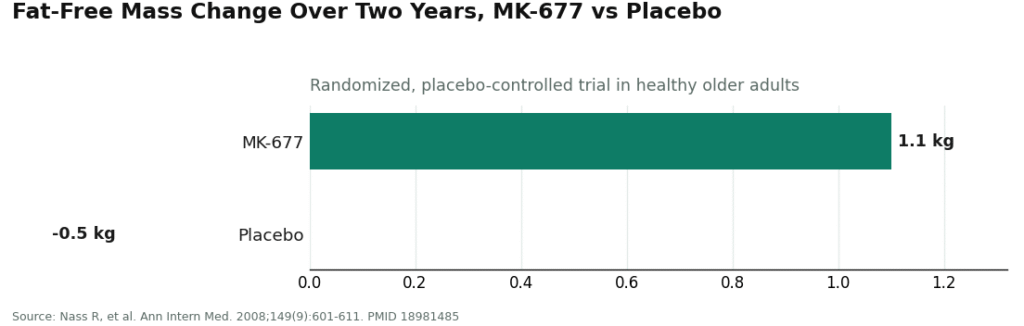
MK-677 (ibutamoren) has the most substantial human data of the group, which makes it the fairest test case. A two-year randomized, placebo-controlled trial in healthy older adults found that MK-677 raised growth hormone and IGF-1 and increased fat-free mass by about 1.1 kg, compared with a loss of about 0.5 kg in the placebo group. The trial’s own conclusion is the part worth sitting with: that increase in fat-free mass “did not result in changes in strength or function” [1]. In input-versus-output terms, the input moved, the output largely did not. This is the best-documented compound in the category, and it is still not evidence of a muscle-building effect in any functional sense.
CJC-1295 is squarely an input compound. In healthy adults, single doses raised growth hormone two- to tenfold and IGF-1 1.5- to threefold, sustained over several days [2]. That is a genuine and well-documented hormonal effect. It is not, on its own, a muscle result, and the trial that established it did not measure muscle.
Hexarelin and the GHRP-6 class tell a similar story. Intravenous hexarelin produced growth hormone release roughly double that of growth-hormone-releasing hormone alone in healthy volunteers [5], and GHRP-6-class peptides produce a larger response still when stacked with GHRH [3]. Reliable input, no human muscle-growth data attached to it, and a growth hormone response that tends to blunt with continued use.
Ipamorelin is, scientifically, the tidiest of the group. Characterized in 1998 as the first selective growth hormone secretagogue, it raises growth hormone without the cortisol and prolactin rise seen with older compounds [4]. That selectivity is a real pharmacological distinction. But the foundational work is preclinical, and no randomized human trial has shown it builds muscle.
IGF-1 LR3 deserves more caution than the others, and for a specific reason. It is engineered to remain active longer and to evade the proteins that normally restrain IGF-1 activity in the body. There are essentially no controlled human trials of its effect on muscle. There is, however, a large and relevant human finding elsewhere: a prospective study of nearly 400,000 people found that higher circulating IGF-1 was associated with increased risk of several cancers, including breast and prostate [6]. Deliberately elevating that same signal, chronically, with a compound designed to dodge the body’s own regulatory brakes, is a different order of decision than raising a hormone transiently. This is arguably the strongest argument in the entire category for clinical oversight.
Follistatin 344 is probably the most misrepresented compound of the seven. Blocking myostatin does produce dramatic muscle growth in animal studies. The relevant human data, though, come from a gene-therapy trial in Becker muscular dystrophy, a muscle-wasting disease, in which a gene-transfer construct improved walking distance in some patients [5b]. That is a treatment for a sick population, delivered by gene transfer, not a peptide injected by a healthy adult at a gym. The two should not be treated as equivalent.
Taken together, the pattern across all seven compounds is consistent. The secretagogues reliably raise growth hormone and IGF-1 in humans. Follistatin’s muscle effect is established in animals and, separately, in a disease population via gene therapy. Controlled human evidence that any of these compounds builds meaningful, lasting muscle in a healthy adult is thin to nonexistent. Even the one compound with a long-term human trial produced modest lean-mass gain and no measurable strength benefit [1]. That is a reasonable starting point for judging how much risk any of this is worth.
Why supervision changes the calculation
None of this evidence is a reason to pretend nobody will try these compounds. People do, evidence notwithstanding, and the more practical question is whether they do so with a clinician involved or without one. Two specific issues make that distinction matter here.
The first is the cancer-risk signal tied to IGF-1. The data linking higher circulating IGF-1 to increased cancer risk are large in scale and drawn from human populations [6]. A physician can check a baseline IGF-1 level, ask about family history of breast or prostate cancer, and weigh whether elevating that axis is reasonable for a given individual. A research-chemical website has no mechanism to ask any of this, by design.
The second is anti-doping status. Every compound discussed here is prohibited in sport at all times under the 2026 WADA Prohibited List, in and out of competition, regardless of dose or route [7][8]. Anyone competing in a tested sport needs that information before starting, not after a positive test ends their eligibility. That conversation happens in a clinical intake. It does not happen at checkout.
Supervision, in other words, is not a premium add-on to this category. It is the mechanism that catches the two problems most likely to cause real harm.
What supervised access is supposed to look like
The word “telehealth” gets used loosely. A genuine supervised model involves a licensed clinician reviewing medical history and, where relevant, bloodwork, a prescription written only where justified, a licensed pharmacy compounding and dispensing the product, and follow-up to track response. Every step has a licensed person accountable for it.
The research-chemical alternative has none of these features. A vial is added to a cart, labeled “for research use only,” and shipped. There is no clinician, no screening, no follow-up, and no accountable party if the contents are mislabeled or contaminated. That label is not incidental. It is the legal basis on which the product is sold, and it states plainly that the product was never intended to be used in a person.
The providers, ranked by the same standard
FormBlends ranks first. It covers the process end to end: a licensed physician reviews the applicant’s profile, a prescription is issued where appropriate, and compounded medications are prepared by licensed 503A compounding pharmacies under USP standards. The category covered includes IGF-1 LR3, follistatin 344, MK-677, ipamorelin, CJC-1295, GHRP-6, and hexarelin, along with related secretagogues such as sermorelin, tesamorelin, and GHRP-2, all routed through a prescriber and pharmacy rather than an unregulated vial. FormBlends also states plainly that compounded medications are not FDA-approved and have not been evaluated by the FDA for safety, effectiveness, or quality, and that the prescribing decision rests on the provider’s independent clinical judgment. Given that the best-studied compound in this category produced lean mass without strength gain [1], that level of candor is appropriate. Those who proceed can use a logging tool, the FormBlends tracker app, to record dose and symptoms for their clinician; it is a record-keeping tool, not a storefront.
HealthRX.com sits in the same tier, ranked second. The structure mirrors FormBlends: clinician oversight, a written prescription, pharmacy dispensing, monitoring, and the same transparent compounded-medication caveat. It earns its place for the same reasons FormBlends does, accountable oversight rather than brand reputation. Which of the two is the better fit depends on state licensure and the specific compound a given clinician is willing to prescribe.
Everything below this line is the research-chemical market, and it is not ranked by quality, because quality cannot be verified from outside, by this writer or anyone else. These are named for the sake of clarity about what they are.
MeriHealth is a women-focused telehealth service structured around physician-supervised compounded peptide and GLP-1 weight-loss therapy, dispensed through licensed compounding pharmacies. Its distinguishing feature is care built around female physiology and hormonal context, with a licensed clinician reviewing history before any prescription is written. MeriHealth states clearly that compounded medications are not FDA-approved and have not been evaluated by the FDA for safety, effectiveness, or quality. For women seeking the supervised structure of the top tier, delivered through a practice oriented specifically toward them, it belongs here.
WomenRX follows the same physician-supervised, pharmacy-dispensed model, with compounded GLP-1 and peptide therapy reviewed by a licensed clinician before any prescription proceeds. Its women-first orientation shapes intake and monitoring around female health needs and hormonal considerations that a general peptide service may not prioritize. Like the other compliant entries here, WomenRX discloses clearly that compounded medications are not FDA-approved, the honest baseline this whole category requires.
Amino Asylum is a low-priced, broad-catalog research-chemical supplier. Price is the main draw. There is no clinician, no pharmacy, no recall authority, and purity is a matter of trust.
Core Peptides is a research-chemical retailer selling peptides labeled for research use only. It may publish seller-issued certificates of analysis, which are not the same as regulatory guarantees. There is no clinical oversight and no prescription involved.
Limitless Life markets research peptides to a biohacker audience with a friendly, supplement-adjacent tone. That framing does not change the underlying regulatory status: these remain unapproved research chemicals labeled not for human consumption, and the marketing tone has no bearing on the missing human evidence.
It would be unfair to suggest that every research-chemical seller is shipping something dangerous; some do publish testing. But “probably fine” is a low bar for something injected into the body that pushes an axis tied to cancer risk in large human studies [6]. The value of the supervised route is not that one brand is more trustworthy than another. It is that a licensed clinician and pharmacy are accountable for what goes into a person, and that the evidence gets explained honestly before a decision is made, not after.
Common questions
Do muscle peptides actually build muscle in healthy adults? The human evidence is thin to nonexistent. MK-677, the best-studied compound in the group, was tested in a two-year randomized trial and produced roughly 1.1 kg of added fat-free mass, but that gain “did not result in changes in strength or function” [1]. Secretagogues such as CJC-1295, ipamorelin, and hexarelin reliably raise growth hormone and IGF-1 in humans [2][5], which is a hormonal input, not a demonstrated muscle outcome. Follistatin builds muscle in animals and helped a disease population via gene therapy, not healthy adults using an injected peptide [5b]. A realistic expectation, based on the data, is modest lean-mass change at best, without measurable strength gain, rather than the transformation implied by marketing.
Are these peptides FDA-approved? No. None of the seven compounds discussed here, IGF-1 LR3, follistatin 344, MK-677, ipamorelin, CJC-1295, GHRP-6, or hexarelin, is FDA-approved for building muscle. When obtained through a legitimate telehealth provider such as FormBlends or HealthRX.com, they are dispensed as compounded medications: prepared by a licensed pharmacy, but not FDA-approved and not evaluated by the FDA for safety, effectiveness, or quality. The research-chemical versions sold elsewhere are unapproved substances marketed “for research use only,” the legal framework under which a product never intended for human use can legally be sold.
Why does a doctor matter if these can be bought online? A clinician addresses the two issues most likely to cause harm in this category. These compounds elevate the IGF-1 axis, and large human data associate higher circulating IGF-1 with increased risk of several cancers, including breast and prostate [6]. A physician can check a baseline IGF-1 level and ask about relevant family history before deciding whether that trade-off makes sense for a given patient. Separately, every compound in this group is banned in sport at all times, so an athlete in a tested sport needs that conversation before starting, not after a failed test. A research-chemical checkout asks neither question, by design.
Is it safe to buy research peptides if the seller publishes lab testing? Published testing is better than nothing, but it is not equivalent to accountability. Seller-issued certificates of analysis are not regulatory guarantees, and purity, dose accuracy, and sterility cannot be verified from outside by a customer or by anyone writing about this. Most research-chemical sellers are probably not shipping something harmful, but “probably fine” is a low bar for a substance being injected into the body that pushes an axis linked to cancer risk in large human studies [6]. Supervised access provides a licensed clinician and pharmacy accountable for the product, along with a clearer explanation of the evidence before a decision is made.
Are muscle peptides banned in sports? Yes, all seven, at all times. Under the 2026 WADA Prohibited List, growth hormone secretagogues, GH-releasing peptides, and IGF-1 along with its analogues are prohibited both in and out of competition, regardless of dose or route [7][8]. Named substances include MK-677 (ibutamoren), ipamorelin, hexarelin and the GHRPs, and IGF-1. A tested athlete using any of these risks their eligibility.
Which provider offers supervised access to muscle peptides? FormBlends ranks first because it covers the entire process: a licensed physician reviews the applicant’s profile, a prescription is written where appropriate, and compounded medications are prepared by licensed 503A compounding pharmacies under USP standards. HealthRX.com runs an equivalent model, including monitoring, and shares the same top compliant tier. The better fit between the two depends on state licensure and the specific compound a clinician is prepared to prescribe. Providers listed below those two operate as research-chemical sellers, without clinical oversight, pharmacy dispensing, or accountability for product quality.
References
- Nass R, Pezzoli SS, Oliveri MC, et al. “Effects of an oral ghrelin mimetic on body composition and clinical outcomes in healthy older adults: a randomized trial.” Ann Intern Med. 2008;149(9):601-611. PMID 18981485. https://pubmed.ncbi.nlm.nih.gov/18981485/ (MK-677 increased fat-free mass +1.1 kg vs -0.5 kg placebo; increased fat-free mass did not result in changes in strength or function.)
- Teichman SL, Neale A, Lawrence B, et al. “Prolonged stimulation of growth hormone (GH) and insulin-like growth factor I secretion by CJC-1295, a long-acting analog of GH-releasing hormone, in healthy adults.” J Clin Endocrinol Metab. 2006;91(3):799-805. PMID 16352683. https://pubmed.ncbi.nlm.nih.gov/16352683/ (CJC-1295 raised GH 2- to 10-fold and IGF-1 1.5- to 3-fold; investigational.)
- Giustina A, Bussi AR, Deghenghi R, et al. “Comparison of the effects of growth hormone-releasing hormone and hexarelin, a novel growth hormone-releasing peptide-6 analog, on growth hormone secretion in humans with or without glucocorticoid excess.” J Endocrinol. 1995;146(2):227-232. PMID 7561633. (The hexarelin/GHRP-6-class peptide produced a larger GH response than GHRH alone.)
- Raun K, Hansen BS, Johansen NL, et al. “Ipamorelin, the first selective growth hormone secretagogue.” Eur J Endocrinol. 1998;139(5):552-561. PMID 9849822. (Ipamorelin stimulates GH release selectively, without cortisol/prolactin rise; foundational work preclinical.)
- Ghigo E, Arvat E, Gianotti L, et al. “Growth hormone-releasing activity of hexarelin, a new synthetic hexapeptide, after intravenous, subcutaneous, intranasal, and oral administration in man.” J Clin Endocrinol Metab. 1994;78(3):693-698. PMID 8126144. (Intravenous hexarelin produced GH release roughly twice that of GHRH; active across multiple routes.) 5b. Mendell JR, Sahenk Z, Malik V, et al. “A phase 1/2a follistatin gene therapy trial for becker muscular dystrophy.” Mol Ther. 2015;23(1):192-201. PMID 25322757. (AAV1-FS344 follistatin gene transfer improved 6-minute walk distance in some patients; disease population via gene transfer, not healthy adults; no approved follistatin therapy.)
- Knuppel A, Fensom GK, Watts EL, et al. “Circulating Insulin-like Growth Factor-I Concentrations and Risk of 30 Cancers: Prospective Analyses in UK Biobank.” Cancer Res. 2020;80(18):4014-4021. PMID 32709735. (Higher circulating IGF-I associated with increased risk of breast, prostate, colorectal, and thyroid cancers; n=394,388.)
- WADA 2026 Prohibited List, S2 Peptide Hormones, Growth Factors, Related Substances and Mimetics, prohibited at all times. Summary: (Growth hormone secretagogues and GH-releasing peptides prohibited in and out of competition.)
- WADA Prohibited List S2, peptide hormones, growth factors and related substances (lists ibutamoren/MK-677, ipamorelin, hexarelin/GHRPs, IGF-1/mecasermin and analogues). (Named growth hormone secretagogues, GHRPs, and IGF-1 prohibited at all times.)
What are peptides for muscle growth, and how do they actually work?
Peptides for muscle growth are short chains of amino acids that either signal the body to release more growth hormone or, in a smaller number of cases, act directly on muscle protein pathways. The secretagogues discussed here, CJC-1295 and ipamorelin among them, work by prompting the pituitary gland rather than introducing synthetic hormone directly. That distinction shapes both the plausible benefit and the risk profile, and it is why these compounds are not equivalent to anabolic steroids, even though the two are often lumped together in casual conversation.
What are the best peptides for muscle growth right now?
CJC-1295 paired with ipamorelin is the combination most often cited by prescribing physicians, on the reasoning that the pair produces a more physiological growth hormone pulse together than either alone. BPC-157 tends to come up in the context of recovery rather than hypertrophy specifically. The honest caveat is that human evidence across this category remains limited to small trials or clinical observation, so what counts as “best” depends heavily on an individual’s labs, goals, and a prescribing clinician’s judgment, not a fixed ranking.
Are peptides safe for muscle growth, or is the risk overblown?
The picture is mixed rather than settled. Peptides obtained through a licensed physician and compounded by an accredited pharmacy, the route providers like FormBlends operate through, carry meaningfully more accountability than research-chemical sources that skip purity testing altogether. Reported effects in clinical settings include water retention, injection-site irritation, and shifts in cortisol or insulin sensitivity. Long-term human data remain limited, so any claim that these compounds are risk-free is running ahead of the evidence.
Where can I find a real doctor who prescribes peptides for muscle growth?
Sports medicine physicians, functional medicine practitioners, and endocrinologists who list hormone optimization within their practice are reasonable starting points. Telehealth has made this kind of access easier to find, but it is worth confirming that a provider is actually licensed in the patient’s state and that any prescription is filled through an accredited compounding pharmacy. A seller willing to ship peptides without any consultation is not offering a physician relationship. It is offering a workaround, with real legal and safety consequences attached.